F1 Pit Crew Salaries
5 Roles
| # | ||||
|---|---|---|---|---|
| 1 | Pit Stop Performance CoachesElite | $250k-500k+ | Elite | $21k-42k+ |
| 2 | Wheel Gun OperatorsHigh | $130k-260k | High | $11k-22k |
| 3 | Tire ChangersHigh | $120k-250k | High | $10k-21k |
| 4 | Jack OperatorsMedium-High | $110k-220k | Medium-High | $9.2k-18k |
| 5 | Car StabilizersMedium | $100k-180k | Medium | $8.3k-15k |
F1 Pit Crew Pay Ladder
F1 Pit Crew Salary By Experience Level
Trainees & Reserves
Core Pit Stop Crew
Senior Pit Stop Specialists
Elite Pit Crew Specialists
F1 Pit Crew Salary By Team
Pay for the same pit crew role changes from team to team. Front-running teams such as McLaren, Ferrari, Mercedes and Red Bull tend to pay at the top of the range and add bigger performance bonuses, while smaller teams such as Haas pay less but often give crew members more responsibility.
Every team works under the same cost cap, which covers most staff pay, so the gap is narrower than it was before 2021. The figures below are estimates for core pit crew members.
11 Teams
| # | |||||
|---|---|---|---|---|---|
| 1 | McLaren | $140k-260k | Front-Running | $12k-22k | |
| 2 | Ferrari | $140k-260k | Front-Running | $12k-22k | |
| 3 | Mercedes | $140k-260k | Front-Running | $12k-22k | |
| 4 | Red Bull | $140k-260k | Front-Running | $12k-22k | |
| 5 | Aston Martin | $120k-220k | Midfield | $10k-18k | |
| 6 | Audi | $120k-220k | Midfield | $10k-18k | |
| 7 | Williams | $120k-220k | Midfield | $10k-18k | |
| 8 | Alpine | $120k-220k | Midfield | $10k-18k | |
| 9 | Racing Bulls | $100k-190k | Smaller Budget | $8.3k-16k | |
| 10 | Haas | $100k-190k | Smaller Budget | $8.3k-16k | |
| 11 | Cadillac | $100k-190k | Smaller Budget | $8.3k-16k |
Estimates based on team budgets and results, cost cap reporting, F1 job listings and industry reporting.
F1 Pit Crew Salaries by Role
How Much Do F1 Tire Changers Make?
Tire changers are responsible for removing and refitting wheels during pit stops, a role where fractions of a second matter and mistakes can directly cost race positions or retirements.

How Much Do F1 Wheel Gun Operators Make?
Wheel gun operators are responsible for loosening and tightening wheel nuts during pit stops, a role where timing, accuracy, and mechanical reliability are critical to safe and fast wheel changes.
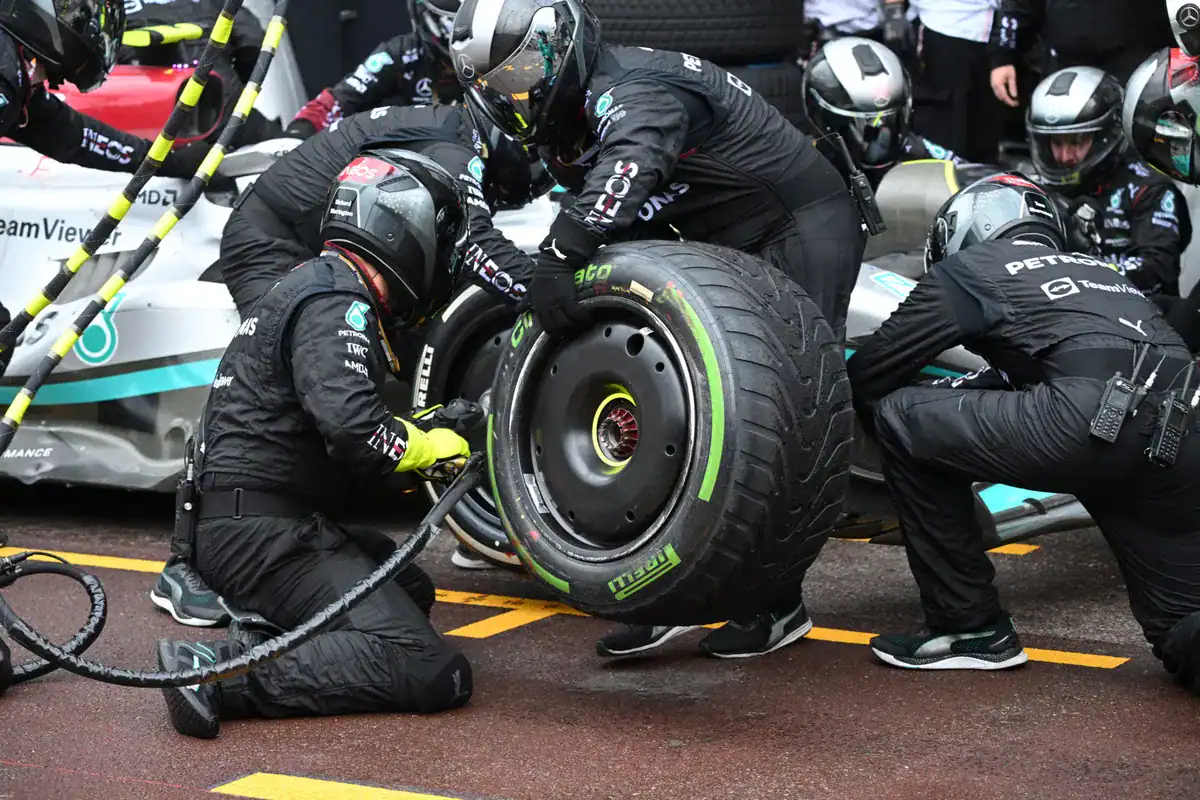
How Much Do F1 Jack Operators Make?
Jack operators lift and steady the car during pit stops so the wheel changes can happen safely and at full speed.

How Much Do F1 Car Stabilizers Make?
Car stabilizers stand at the sides of the car during a pit stop and hold it steady while the tires are changed. Their job is to stop the chassis rocking as the jacks lift and drop it, which keeps the wheel guns lined up and protects the car from damage.
The role looks simple, but it is timed to the hundredth of a second alongside the rest of the crew. Stabilizers train with the full crew every week, and a clean, well-drilled stabilizer is part of why top teams can complete stops in around two seconds.

How Much Do F1 Pit Stop Performance Coaches Make?
Senior or lead mechanics oversee groups of race mechanics and specialists. They coordinate work in the garage and act as the link between technical engineers and the pit crew during a race weekend.

Additional Information
F1 Pit Crew Bonuses & Additional Compensation
In addition to base salaries, F1 pit stop crew members can earn significant additional compensation through performance-related bonuses and travel allowances linked to race results and pit stop execution.
Race Win Bonuses
Pit stop crew are often paid a bonus when their team wins a race, typically ranging from $2k to $10k per win depending on role and seniority.
Constructors’ Championship Bonuses
Similar to F1 driver salaries, end-of-season championship bonuses may be paid based on final Constructors’ Championship position and can total 10-30% of base salary for senior pit stop staff at top teams.
Pit Stop Performance Bonuses
Some teams offer internal bonuses linked to pit stop metrics such as average stop time and error rates, worth an estimated $10k-50k across a season for senior operators and coaches.
Travel and Overtime Allowances
As part of the traveling race team, pit stop crew may receive travel and overtime allowances, commonly contributing an additional $10k-30k per season.
For a side-by-side look at how this pay compares with other team jobs, see our pit crew vs mechanic vs engineer pay comparison.
frontofficesports.com | formulaonehistory.com

Do F1 Teams Pay Pit Stop Crew Differently?
Yes. F1 teams pay pit stop crew differently mainly through bonuses and performance incentives, rather than large differences in base salary.
Base Pay
Core pit stop roles typically earn $120k-220k with senior specialists earning $220k-350k regardless of team.
Front-Running Teams (e.g. Red Bull, McLaren, Ferrari)
Frequent race wins and championship contention can push total annual earnings to $300k-400k+ once bonuses are included.
Midfield vs Lower-End Teams
Midfield teams usually offer similar base pay with fewer bonuses, while lower-end or rebuilding teams may pay slightly higher base salaries to attract experience, but with limited bonus upside.
What Makes the Difference?
Win frequency, Constructors’ Championship position, internal pit stop incentives, and staff retention pressure matter more than team name alone, so identical roles can earn very different totals.
motorsportengineer.net | themanual.com
Explore More F1 Staff Salaries


F1 Pit Crew Salaries: FAQs
Most F1 pit stop crew members start in factory, garage, or race mechanic roles before being identified for pit stop training. Teams look for exceptional consistency, physical ability, and composure under pressure. Crew members can spend years in training and simulation before being trusted in live race pit stops.
A modern F1 pit stop typically involves around 20 crew members, though only a subset directly handle the car. This includes tire changers, wheel gun operators, jack operators, stabilizers, and backup personnel. Additional performance and support staff oversee execution, safety, and coordination during race weekends.
F1 pit stop crew are full-time employees, not contractors. Outside race weekends, they train extensively using pit stop rigs, simulation drills, and performance analysis. Preparation, fitness, and repetition are year-round commitments, with race weekends representing only a small portion of their overall workload.
Pit stop roles are extremely physically demanding, requiring strength, speed, and precision under intense time pressure. Crew members must repeatedly perform explosive movements while wearing protective equipment, often after long travel schedules. Fitness and conditioning are critical, and some teams recruit from athletic or military-style physical backgrounds.
Pit stop crew careers can last 10-15 years or more, particularly for those who transition into senior specialist or performance roles. While the physical demands are high, experienced crew often move into mentoring, training, or optimization positions, which lets them keep working beyond their physical peak.
Yes. Most F1 pit crew members are full-time team employees, usually race mechanics or technicians who also train for pit stops. They spend race weekends performing stops and work in the garage or factory between events, so their salary covers far more than the few seconds of each pit stop.
Pit crew members are paid an annual salary rather than a fee per race. Spread across a 24-race calendar, a core crew salary of $120k-220k works out to roughly $5k-9k per race weekend, before bonuses for podiums, wins and fast pit stop records.